
Dummy Coyote-Smarty Roadrunner
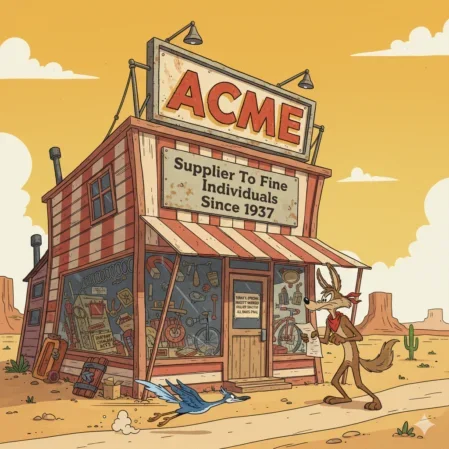
DUMMY COYOTE & SMARTY ROADRUNNER - SIMULATION OVERVIEW & LEARNING OBJECTIVES
1. WHAT THE SIMULATION DOES
--------------------------------------------------------------------------------
The "Dummy Coyote & Smarty Roadrunner" simulation is a humor-infused, merchandising
bookkeeping simulation based on classic cartoon tropes. The student is hired as
the bookkeeper for Smarty Roadrunner's "Acme Store" (or "Acme Traps"), recording
sales and operational transactions for products sold to Dummy Coyote (such as Giant
Rubber Bands, Rocket-Powered Roller Skates, Dehydrated Boulders, and DIY Tornado Kits).
The simulation is offered in two distinct version formats:
A. Weekly Reporting Version (77–78 Transactions):
- Covers a full month of startup/retail activity organized into 4 weekly cycles.
- At the conclusion of each operating week, the simulation generates full
periodic financial reports (Income Statement and Balance Sheet) for student review.
B. Monthly Humorous Sales Version (81 Transactions):
- Features rich, comedic transaction narratives detailing Coyote's dubious
product purchases, malfunctions, complaints, and returns.
- Aggregates the entire month's operational cycle into end-of-month statements,
formal Special Journals, General Ledger T-accounts, Unadjusted Trial Balance,
and automated Period-End Closing Entries.
Core Interactive Engine & Mechanics:
- Two-Step Journalizing Engine:
* Step 1: Identify and select the correct Special Journal (Sales Journal,
Cash Receipts Journal, Purchases Journal, Cash Disbursements Journal, or
General Journal).
* Step 2: Select the correct Accounts and post balanced Debits and Credits.
- Two-Entry Perpetual Inventory Rule:
* For retail merchandise sales, the engine reinforces that sales transactions
require two separate entries:
1. Recording the revenue and receivable/cash (Debit Cash/AR, Credit Sales).
2. Recording the inventory reduction and cost of goods sold
(Debit Cost of Goods Sold, Credit Merchandise Inventory).
- Point-Based Scoring & Live Dashboard:
* Points awarded for selecting the right journal (+1 pt) and right accounts (+1 pt).
* Live status gauges for Cash, Accounts Receivable, Inventory, Accounts Payable,
and Sales.
2. WHAT THE STUDENT LEARNS
--------------------------------------------------------------------------------
The simulation provides practical training in merchandising business operations,
perpetual inventory recording, and specialized journalizing:
A. Specialized Journals vs. General Journal:
- Understanding why growing merchandising businesses segregate routine
high-volume transactions into specialized journals:
* Sales Journal: Credit sales of merchandise.
* Cash Receipts Journal: All incoming cash flows.
* Purchases Journal: Merchandise purchases on credit terms.
* Cash Disbursements / Cash Payments Journal: All outgoing cash payments.
* General Journal: Adjusting entries, closing entries, and non-routine events.
B. Perpetual Inventory Accounting & Cost of Goods Sold (COGS):
- Mastering the standard two-entry perpetual merchandising mechanism on sales.
- Handling customer returns, allowances, and damaged merchandise write-downs.
C. Trade Credit & Working Capital Management:
- Managing customer billing and receivables on account (Dummy Coyote's tab).
- Managing trade payables to wholesale suppliers for retail inventory restocking.
D. Weekly vs. Monthly Financial Performance Review:
- Analyzing interim weekly Income Statements and Balance Sheets to evaluate
short-term cash burn, inventory turnover, and weekly gross profit margins.
- Tracing weekly performance into cumulative monthly totals.
E. Trial Balance & The Period-End Closing Cycle:
- Verifying equality between total general ledger debits and credits on the
Trial Balance.
- Understanding the closing entry sequence that clears temporary accounts
(Revenues, Expenses, and COGS) into Owner's Equity at the end of the month.
Instructions and Answers are included.
What does the simulation look like ?

Break Time: Watch the Road Runner Cartoons